
-
15 August 2025 | Country Update
Slovakia’s €2 billion ambulance tender sparks political and legal turmoil -
15 July 2025 | Policy Analysis
Steps to reform emergency medical services in Slovakia
5.5. Urgent and emergency care
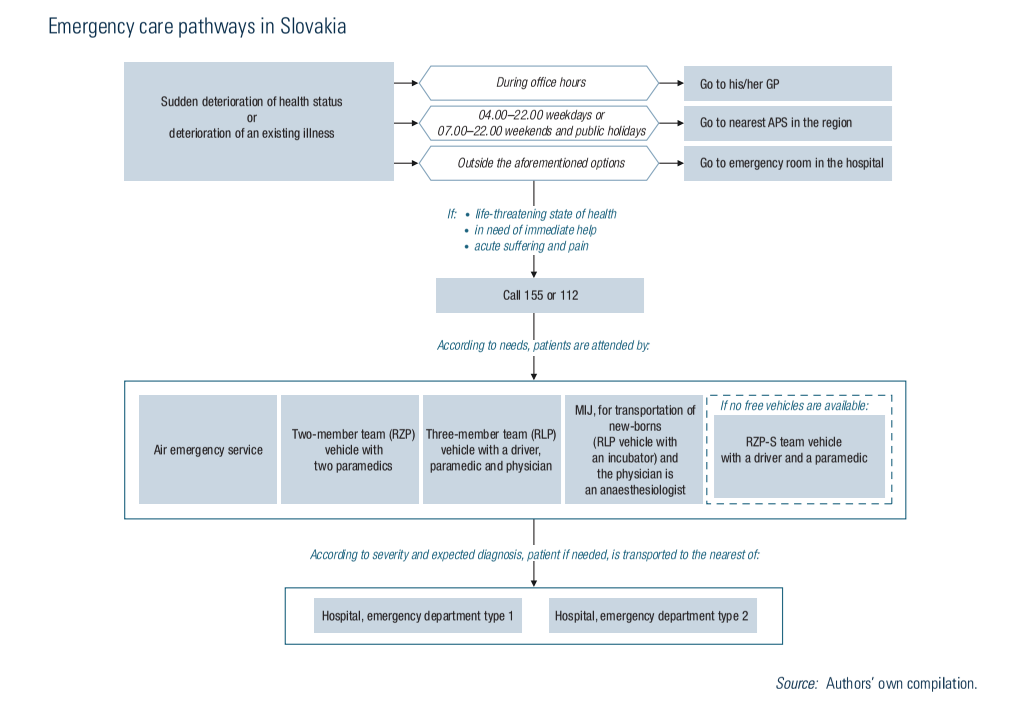
Emergency care is for sudden life-threatening situations or care during childbirth. The standard emergency number for Slovakia (155) connects callers to triagers directly in one of eight command centres; callers can also dial the European emergency number (112) (see Fig5.6). Emergency calls are received at the state-run Emergency Medical Service Operations Centre (Operačné stredisko záchrannej zdravotnej služby, OS ZZS), which dispatches ambulances. OS ZZS is fully financed by HICs and employs 445 people with a 2024 budget of approximately €25 million (OS ZZS, 2024).
Fig5.6
Ambulance services are provided by both public and private entities and are subject to a procurement process administered by ÚDZS. Licences for the provision of emergency medical services are issued for a period of six years based on the tender and licensed providers are awarded with social health insurance contracts. The expected budget for these services is €221 million for 2024 (Ministry of Finance, 2024b). The next bidding process will be in 2025, administered by MZ SR, owing to a scandal during the last bidding process that led to the removal of the ÚDZS President (TASR, 2020).
In 2024, 81 out of 328 emergency medical service points consisted of a three member and physician-led team (rýchla lekárska pomoc, RLP), 187 points were operated by two paramedics (rýchla zdravotná pomoc, RZP), and there were seven emergency medical service helicopters and five mobile intensive care units (mobilná intenzívna jednotka, MIJ) for the transport of, for example, newborn babies. In 2020 a new type of provider (rýchla zdravotná pomoc – sekundárne prevozy, RZP-S) was commissioned to be primarily in charge of inter-hospital transport. There are 48 of these points in 2024. The law requires ambulances to dispatch within two minutes’ notice.
There are 13 emergency medical service providers in Slovakia, of which the state operates two (but comprising about half of all points), and the rest is split among three larger private providers, with smaller regional hospitals having a few points (ÚDZS, 2019b; OS ZZS, 2024). Emergency health service points are based on a 2004 reform, which set the goal of achieving availability of urgent health care within 15 minutes after receiving an emergency call for 95% of the population. The average response time in 2023 was 10:47 minutes for primary calls with a physician onboard and 12:39 minutes for RZP transports. In fact, the availability for 95% of the population was approximately 25 minutes and has been increasing recently, despite the inclusion of 46 ambulance RZP-S vehicles, which were supposed to relieve primary transports. These vehicles started to be used to cover for overloaded primary vehicles and in 2023, 60% of RZP-S interventions were primary transports that RZP-S vehicles were not supposed to perform at all.
As part of the RRP, MZ SR has prepared a new network of emergency services. The new goals were lenient, intended to cover 90% of the population within 15 minutes, and 80% of patients with a quintet[12] diagnosis in the first hour responded to with an ambulance within eight minutes of dispatch (Recovery and Resilience Plan, 2021a). The first draft of the new network was published in December 2023 but was criticized by experts for falling short of targets (Krempaský, 2023b); MZ SR pledged to rework the analysis. MZ SR prepared new legislation in winter 2024, but as of the time of writing, it is still to be approved by the government (MZ SR, 2024h).
Emergency care pathways have undergone several changes over the last five years. Until 2018 emergency services were defined as the Medical First Aid Service (lekárska služba prvej pomoci, LSPP) in the outpatient setting and inpatient emergency services in hospitals. Both types functioned around the clock, with the outpatient emergency service aimed at those patients who were not acute (for example, those with fevers, allergic reactions, minor injuries). In contrast, the inpatient emergency service dealt with urgent medical care (more severe injuries, fractures, suspected heart attacks, strokes) and patients brought in by emergency medical services.
Both the LSPP and the emergency room departments were, in theory, open to provide 24/7 services for patients. In practice, however, regional accessibility, opening hours and quality of services differed, due to a lack of physicians and/or equipment. In 2018 changes were approved including the following.
- LSPP services would be renamed as the Ambulatory Emergency Service (ambulantná pohotovostná služba, APS) with a precise named list of locations, a fixed flat fee for the provision of services and legally defined opening hours (16:00–22:00 on weekdays and 19:00–22:00 at weekends). Pharmacy services were also linked to the new APS points (Bendová, 2018) to ensure full outpatient access for patients. As of 1 July 2024, APS for children is open until 20:00, due to shortages of paediatricians (TASR, 2024c). The fee for using the service is fixed at €2 per visit.
- Regulating the functioning of hospital emergency rooms. As of 15 January 2018, with a transitional provision from 2020 (to allow hospitals to prepare), a fixed network of emergency admissions that HICs are obliged to contract was defined in two levels: urgent admission type 1 (with a flat rate of €55 380 monthly) and urgent admission type 2 (€157 629 per month for a general hospital in 2023) (ÚDZS, 2023d). In 2024, 32 type 1 and 13 type 2 emergency admissions are included in the fixed network in the decree. Both types have clearly defined minimum staffing norms, availability of specialties and emergency room equipment, but type 2 departments are more complex and can further specialize into trauma centres. This division was intended to ensure population accessibility while centralizing resources and became the basis for the hospital network reform of 2021. The fee for using the hospital emergency room was introduced in 2018 as €10 per visit, providing the patient is not hospitalized.
- 12. A group of conditions where immediate treatment is critical and emergency medical services can provide substantial benefit. Includes: cardiac arrest/circulatory arrest, difficulty breathing, chest pain, stroke and severe trauma. ↰
Slovakia is facing a major public procurement controversy involving the tendering of its emergency medical services. The EUR 2 billion contract, covering both ground and air ambulance operations from 2025 to 2031, has become the largest healthcare tender of the current government – and is now mired in allegations of cronyism, lack of transparency and possible breaches of procurement law. Political tensions, media scrutiny and prosecutorial involvement have converged to make this one Slovakia’s most significant governance crises of 2025.
Tender overview
The Operational Centre of the Emergency Medical Service, on behalf of the Ministry of Health, launched the tender to allocate licences for 344 ground ambulance stations and 7 air ambulance bases nationwide in May 2025. The aim was to ensure the provision of high-quality, continuous emergency services across Slovakia. The winning bidders would secure operational rights for a six-year period, with the contract value estimated at EUR 2 billion (The Slovak Spectator, 2025a).
Transparency concerns
Criticism quickly emerged from opposition parties, the Slovak Medical Chamber and transparency watchdogs. They highlighted opaque selection procedures, including a refusal to disclose the names and qualifications of tender committee members.
In July 2025, preliminary results of the tender and the names of the commission members were leaked to the media, which confirmed concerns about poor transparency and fairness of the tender (The Slovak Spectator, 2025a).
One particularly contentious claim is that the tender process might be structured to favour certain bidders, notably Agel SK, Slovakia’s second-largest private healthcare provider, and a relatively unknown entrant, Emergency Medical Solutions (EMS). Both have reportedly been in positions to gain a disproportionately large share of contracts (The Slovak Spectator, 2025b). EMS was later proven to be linked to the second largest coalition party, HLAS-sociálna demokracia, which also nominated (as of this writing) incumbent Minister of Health, Kamil Šaško.
As a consequence, on 8 August 2025, Penta Hospitals, Slovakia’s largest private healthcare network, withdrew its bid, citing serious concerns over transparency and suggesting possible breaches of EU procurement law (The Slovak Spectator, 2025b).
The Slovak National Party (SNS), another governing coalition partner, demanded not only the cancellation of the tender but also the resignation of Health Minister Šaško. Prime Minister Robert Fico publicly acknowledged that the process could be scrapped or restarted if doubts persisted (TASR, 2025).
The General Prosecutor’s Office, led by Maroš Žilinka, initiated a preliminary review into the tender process. This action signals potential criminal investigations for alleged mismanagement of public funds and violations of procurement rules (The Slovak Spectator, 2025b).
Nevertheless, the management of the Operational Centre of the Emergency Medical Service delivered the results of the tender to the Ministry of Health on 11 August, thereby de facto announcing the successful selection procedure. On the same day, Minister of Health Šaško, announced that he would not sign it and would cancel the tender procedure, and would come up with an alternative for procuring emergency services in Slovakia, pending agreement within the governing coalition. Conclusions of such discussions are expected by the end of August 2025.
The opposition and experts claim that Health Minister Šaško could not terminate the tender and did so in violation of the law, which may cause the bidders to suffer lost profits, and are therefore demanding his resignation (TASR, 2025b).
Authors
References
The Slovak Spectator (2025a) News digest: Unqualified officials, secret committees. Ambulance tender raises red flags. SME.sk. Available at: https://spectator.sme.sk/politics-and-society/c/news-digest-unqualified-officials-secret-committees-ambulance-tender-raises-red-flags (Accessed: 15 August 2025).
The Slovak Spectator (2025b) News digest: Ambulance tender turmoil – Penta walks, prosecutor limbers up. SME.sk. Available at: https://spectator.sme.sk/politics-and-society/c/news-digest-ambulance-tender-turmoil-penta-walks-prosecutor-limbers-up (Accessed: 15 August 2025).
TASR (2025) Ambulance tender scandal: Political pressure mounts, PM and SNS weigh in. TASR. Available at: https://www.tasr.sk/tasr-clanok/TASR%3A2025080700000344 (Accessed: 15 August 2025).
TASR (2025b) According to Šaško, the tender for ambulances was cancelled in accordance with the law. “Anyone who questions this is lying”, he said. PRAVDA. Available at: https://spravy.pravda.sk/domace/clanok/763156-sasko-tender-na-zachranky-bol-zruseny-zakonnym-sposobom Accessed: 15 August 2025).
General overview
In March 2025, the Slovak Government approved the most significant reforms to the emergency medical services (EMS) system in over two decades. Although the initial implementation date was set for 1 January 2025, the new legislation will be introduced in phases, and commenced on 15 April 2025. It includes structural changes to ambulance services, the development of a new ambulance network and the introduction of a new professional role.
Structural changes to ambulance services
Several new types of ambulance crews will be deployed. One of the most notable is the hybrid rapid medical assistance (RLP)/rapid medical aid (RZP) model, whereby a physician-staffed RLP unit will operate during daytime hours, and an RZP crew without a physician at night. This measure is designed to optimize the use of physicians, whose availability in the Slovak health system is limited.
Another innovation is the RZP crew with extended-scope specialist paramedics. These paramedics will be authorized to perform advanced medical interventions previously reserved for physicians, with the intention of accelerating care delivery, particularly in remote or underserved areas.
The reform also introduces specialized ambulance types, including:
- Planned transport ambulances for non-emergency inter-hospital transfers and selected low-acuity primary calls, freeing doctors and paramedics for acute cases.
- Mobile paediatric intensive care unit ambulances, operated by tertiary paediatric healthcare facilities, to ensure critically ill children are transported by personnel trained in paediatric emergency medicine.
- Emergency medical assistance ambulances for repatriation (if a patient is abroad and needs transport back to Slovakia) and other non-insurance-covered transport needs, such as medical coverage at social, cultural and sporting events.
Development of a new ambulance network
The EMS network will be redesigned based on a mathematical optimization model that uses historical data on response times, call volumes, call types and geographic distribution of incidents. This model will propose optimal crew deployment to minimise response times and maximize coverage.
As a result, the number of ground ambulance service stations in Slovakia will increase from 321 to 344 from the next tendering period, beginning in Autumn 2025. Additionally, the reform specifies more precise regulations for the location of EMS stations in regional capitals to improve equitable access across urban areas and surrounding municipalities.
A commission within the Ministry of Health will monitor compliance with newly established quality indicators for both EMS providers and emergency dispatch centres. The first set of indicators was published in the Official Gazette in mid-2025, with systematic measurement scheduled to commence in 2026.
Introduction of a New Healthcare Professional Role
The legislation also creates a new category of healthcare worker: the transport assistant. Transport assistants, similar in status to nurses within the EMS system, will be formally registered with the Slovak Chamber of Emergency Medical Technicians. This ensures both professional representation and access to continuous professional development opportunities.
Another key feature of the reform is the planned introduction of a new emergency telephone number, 116117, in January 2026. This number will handle non-urgent medical inquiries, thereby alleviating the workload on the existing emergency number 155, which will continue to be reserved for urgent, life-threatening cases. The aim is to enable EMS teams to concentrate their resources on critical incidents requiring immediate intervention.
References
Fekete, B. (2025) Vláda schválila najväčšiu reformu záchraniek za posledné roky. Čo nás čaká? (The government has approved the biggest reform of the emergency services in recent years. What can we expect?). MEDICINA Trend. Available online from: https://medicina.trend.sk/2025/03/12/vlada-schvalila-najvacsiu-reformu-zachraniek-za-posledne-roky-co-nas-caka
Jeseňák, Š., Gaston, I. and Majerský, F. (2025) František Majerský & Gaston Ivanov: Najväčšia reforma záchrannej zdravotnej služby za 20 rokov s cenovkou 1,2 miliardy € (František Majerský & Gaston Ivanov: The biggest reform of the emergency medical services in 20 years, with a price tag of €1.2 billion). Ozdravme.sk Available online from: https://www.ozdravme.sk/Dokument/101831/frantisek-majersky-gaston-ivanov-najvacsia-reforma-zachrannej-zdravotnej-sluzby-za-20-rokov.aspx