
-
13 January 2023 | Country Update
Ontario to outsource elective or non-urgent care to private sector providers -
22 August 2022 | Country Update
Provinces look to expand private sector to address pandemic-associated medical and surgical backlogs
5.4. Specialized care
In Canada, virtually all secondary, tertiary and emergency care, as well as the majority of specialized ambulatory care, is performed in hospitals. Based on the typology introduced by Healy & McKee (2002), the prevailing trend for decades has been towards the separatist model of acute care rather than a comprehensive model of hospital-based curative care. In the separatist model, the hospital specializes in acute and emergency care, leaving primary care to GPs or community-based health care clinics and institutional care to LTC homes and similar facilities. A clearly noticeable trend in Canada is for the consolidation of tertiary care in fewer, more specialized hospitals, as well as the spinning off of some types of elective surgery and advanced diagnostics to specialized clinics.
Historically, hospitals in Canada were organized and administered on a local basis, and almost all were administered at arm’s length from provincial governments (Boychuk, 1999; Deber, 2004). In the provinces and territories that have regionalized or have a delegated health authority, hospitals have been integrated into a broader continuum of care either through direct health authority ownership or through contract with health authorities. Where the hospital is owned by the health authority, the hospital boards have been disbanded and senior management are employees of the health authority. Where the hospital continues to be owned by religious or secular civil society organization – almost all of which are non-profit organizations with charitable status – they continue to have a board and senior management that is independent of the health authority. However, since these hospitals derive most of their income stream from the health authorities, they generally conform to the overall objectives of the health authority and are integrated to a considerable degree into the health authority’s continuum of care services.
Authors
Authors
References
Alberta. (2022, February 22). Speech from the Throne: February 22, 2022. Government News. https://www.alberta.ca/news.aspx
Doolittle, R. (2022, April 2). Canada’s hospital capacity crisis will remain long after the pandemic is over. The Globe and Mail. https://www.theglobeandmail.com/canada/article-canada-hospitalizations-covid-19-pandemic/
Longhurst, A. (2022). The concerning rise of corporate medicine. Canadian Centre for Policy Alternatives. https://policyalternatives.ca/corporate-medicine
Ontario. (2022, August 18). Plan to Stay Open: Health System Stability and Recovery. Ontario.Ca. http://www.ontario.ca/page/plan-stay-open-health-system-stability-and-recovery
Saskatchewan. (2022, August 15). Request for Proposal Issued for Third Party Surgical Provider. Government of Saskatchewan. https://www.saskatchewan.ca/government/news-and-media/2022/august/15/request-for-proposal-issued-for-third-party-surgical-provider
Tait, C. (2022, February 22). Alberta Throne Speech outlines plans to boost private surgeries, expand charter schools. The Globe and Mail. https://www.theglobeandmail.com/canada/alberta/article-alberta-throne-speech-outlines-plans-to-boost-private-surgeries-expand
The Canadian Press. (2022, September 3). CAQ proposes 2 private medical centres in Montreal, Quebec City to ease hospital strain |. CBC News. https://www.cbc.ca/news/canada/montreal/caq-hospital-strain-private-centres-1.6572146
Vescera, Z. (2022, July 28). Sask. NDP tell government to scrap private surgery funding plans. Saskatoon StarPhoenix. https://thestarphoenix.com/news/saskatchewan/sask-ndp-tell-government-to-scrap-private-surgery-funding-plans
5.4.1. Specialized ambulatory care and day services
Specialized ambulatory services are generally provided in outpatient departments of hospitals. There has been a growth in recent decades in the number of facilities outside of hospital that provide advanced diagnostic and surgical services, most of which are for-profit with an ownership mix of small business/provider and corporate. Surgical procedures that are performed in non-hospital facilities vary across the provinces but generally are limited to high volume, low complexity procedures that do not require overnight stay such as ophthalmologic (e.g. cataracts), orthopaedic (e.g. joint replacement) and dermatologic procedures. However, there has been resistance to this trend from various groups including the Canadian Union of Public Employees (CUPE), the largest public sector unions in Canada, and the Canadian Centre for Policy Alternatives, a left-leaning public policy think tank which has argued that expanding private delivery will result in poorer quality care and higher administrative costs (Longhurst et al., 2016).5.4.2. Inpatient care
The most common reason for hospitalization in Canada is giving birth, and the most common inpatient surgery is caesarean section delivery. Only 2% of births in Canada are outside of hospital, a percentage that has been stable from 2013–2017 (Statistics Canada 2019h); and the overall caesarean section rate for Canada is 29% of all hospital births (CIHI, 2019c). The other top reasons for hospitalization are chronic obstructive pulmonary disease (COPD), bronchitis and acute myocardial infarction (AMI) (CIHI, 2019c). Over time there has been a shift away from inpatient care towards outpatient care, including day surgeries. In addition to the gradual decrease in ALOS and (age- and sex-standardized) hospitalization rates in Canada (see Chapter 4), the volume of outpatient care has increased by 25% since 2005 compared with an increase in inpatient volume by 17% (CIHI, 2019c).
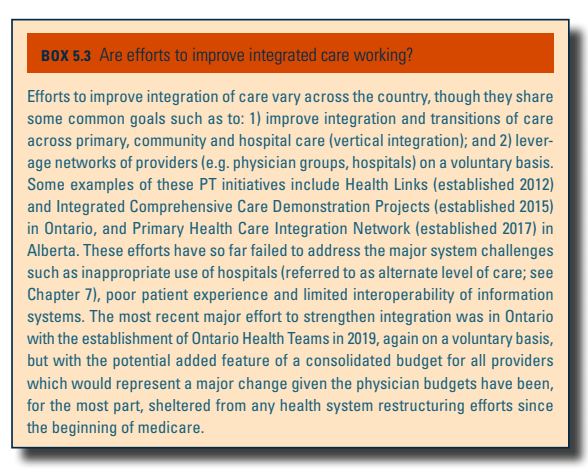
See Box5.3 for efforts to improve integrated care and Box5.4 for patient evaluations of hospital care.
| Box5.3 | Box5.4 |
 |  |