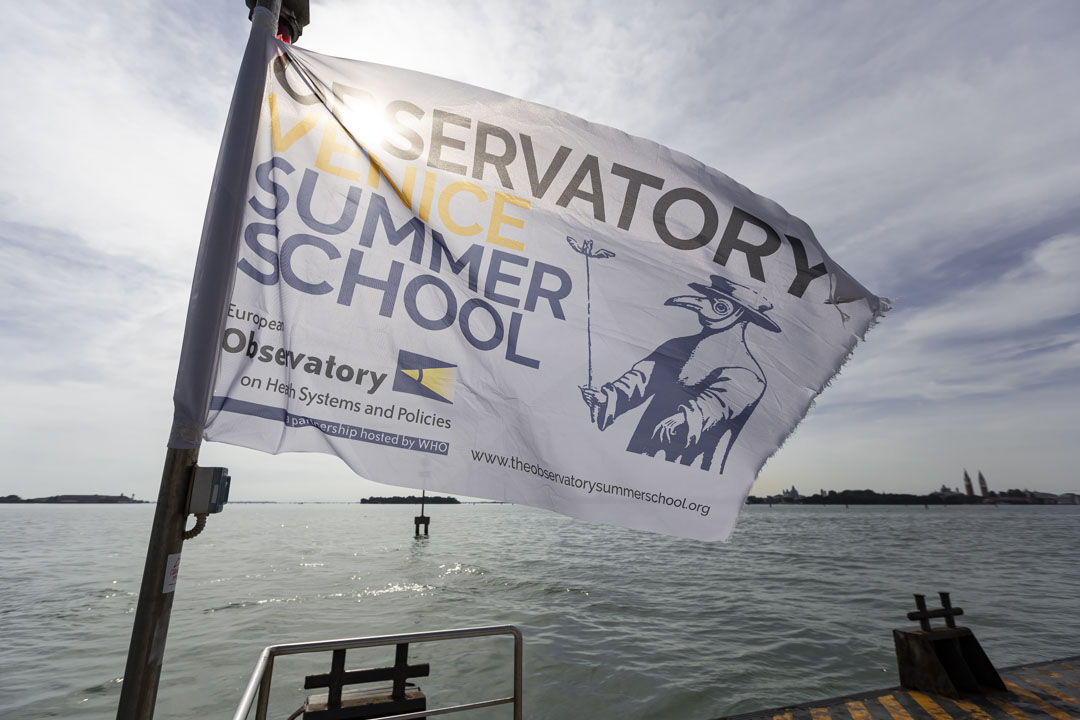
Does Health System Performance Assessment (HSPA) actually improve performance? Designing HSPA to enable better policy decision making
Sunday 20 to Saturday 26 July 2025 - Venice, Italy
Only a few more days left to apply!!
Given the high interest in the European Observatory Venice Summer School 2025 on HSPA, applications will be closed on Friday, 16 May 2025.
The school starts on Sunday, 20 July in the afternoon (opening at 5:00 pm) and ends on Friday 25 July with an evening of celebration. Departure day is Saturday 26 July 2025.
The course takes place ‘live’ on San Servolo island in Venice and cannot be followed online.
The School addresses “users” of HSPA such as policy makers at national, regional, and local level who are working to improve health system performance, as well as those involved in HSPA framework design, data collection and analysis.
Rationale and focus: Health policy-making and reforming health systems requires a sound understanding of how a health system is performing. HSPA is an iterative approach that provides crucial information on key dimensions of performance: accessibility, quality, population health, responsiveness and efficiency. The Summer School will explore different ways to conceptualize a “health system”, looking at different frameworks, linking functions with performance dimensions, and considering relevant indicators for measuring performance in various ways. Beyond an academic exercise, the importance of this course is that it will show how HSPA can support policy-makers in practice, as they strive to improve overall health system performance.
Content: The course will address definitions and rationale, conceptual and methodological approaches, alongside the practical use of HSPA for policy-makers and the politics around it. The course covers dedicated modules on:
- What is health system performance assessment (HSPA)? Why bother?
- How to measure health system performance: frameworks, dimensions and (tracer) indicators
- How to use HSPA and its policy pathways to inform health policy and health system reform
- The politics of HSPA – national and international experience
Approach: The six-day course includes formal teaching, panel discussions and has at its core the practical experiences of participants. A highly participative approach allows real engagement, with group work that cuts across themes, participant presentations, round tables and panel discussions. The course mobilizes the latest evidence, with a multidisciplinary team of experts from the health policy, economics, and social sciences fields who will offer insights into this complex area. It is an opportunity to share perspectives with and gain insights from key international organizations active in HSPA, including the European Commission and WHO. The course follows in the Summer School tradition, which fosters evidence-informed policymaking and encourages a European debate on health policy by raising key issues, sharing learning and building lasting networks.
Accreditation: The Summer School applies to the European Accreditation Council for Continuing Medical Education and it is expected that participation will count towards ongoing professional development in all EU Member States.
Organization: The Summer School is organized by the European Observatory on Health Systems and Policies, the Veneto Region of Italy, the European Commission and World Health Organization (WHO).
Applying: The Summer School is primarily aimed at mid- to senior- level policymakers although more junior professionals will be considered. All participants should be working in a decision-making or advisory function in a governmental or non-governmental context – such as ministries, (public) health institutes, regulatory or funding bodies, provider, and professional associations - and ideally on health system performance issues and / or performance measurement.
Applications are welcome from all 53 WHO European Region Member States, and the programme will be tailored as far as is possible to the backgrounds of participants. If places allow, participants from outside the Region will be considered.
Applications are now closed.
The cost of € 2,600 includes: teaching, 6 nights’ accommodation, meals, transfer from/to the Marco Polo International airport on Sunday 20 and Saturday 26 July 2025, public transport from/to the island-Venice, high-level panels, and a social programme.
| Preparation: - The course involves only limited preparation - All materials will be available in due course at www.theobservatorysummerschool.org. |
|---|
The European Observatory on Health Systems and Policies supports and promotes evidence-informed health policymaking through the comprehensive and rigorous analysis of the dynamics of health systems in Europe and beyond. It is a WHO-hosted partnership that includes a range of partners, including international organisations (the WHO Regional Office for Europe, European Commission); national governments and regional governments (Austria, Belgium, Finland, Ireland, the Netherlands, Norway, Slovenia, Spain, Sweden, Switzerland, the United Kingdom, Italy’s Veneto Region with Agenas); other health system actors (CNAMS, - the French National Union of Health Insurance Funds - the Health Foundation), and academia (the London School of Economics and Political Science, and the London School of Hygiene & Tropical Medicine).
The Observatory has three hubs based in Brussels (Secretariat), London (London School of Hygiene and Tropical Medicine & London School of Economics) and Berlin (Technical University of Berlin).
The European Commission is the EU's executive body. It represents the interests of the European Union as a whole (not the interests of individual countries). The Commission is committed to make Europe a healthier, safer place, where citizens can be confident that their interests are protected. It has been a partner of the European Observatory since 2009 and is promoting and facilitating the exchange of best practice, and supporting periodic monitoring and evaluation.
The Veneto Region seeks to ensure that empirical evidence and analysis reaches national and regional stakeholders and policy-makers. It is involved in comparing health care systems across EU Member States. The Veneto Region is active in the area of cross-border health care and plays a leading role in the EU in research and policy development. The Veneto Region, which has been a partner of the European Observatory since 2004, is hosting the Summer School because it is committed to providing a European platform for political debate on health matters, linking regional authorities to the EU debate.
The World Health Organization Regional Office for Europe’s Division of Country Health Policies and Systems (CPS) aims to assist Member States assists countries with: the design and implementation of appropriate health policies and systems to strengthen universal health coverage; advocates for the strengthening of public health leadership to ensure people centred policies; and focuses on building capacity for health system innovation. WHO Europe hosts the Observatory partnership. CPS and the Observatory work in close collaboration on a range of activities including the development of policy briefs and dialogues to support decision making and other knowledge-brokering initiatives.
For more information and regular updates on the programme and lecturers: www.theobservatorysummerschool.org